So, What Makes An Animation ‘Islamic’? Part Two
Our voyage into Islamic animation continues, and this time, we examine creative animation productions inspired by Shia institutions from Kuwait to Lebanon.
In part one, Omar Sayfo sifted through examples of Islamic animation primarily from the Sunni perspective. Now, he turns his historical eye towards animation crafted by Shia institutions.
Unlike their Sunni peers, Shia animation producers of the Arab world have a relatively strong visual heritage to draw upon when articulating their own particular style. Meanwhile, exclusive religious narratives provide a rich source for plots to address a Shia audience. Clearly, such productions have limited potential to reach a general Muslim audience.
Shia animation producers of the Arab world have a relatively strong visual heritage to draw upon when articulating their own particular style.
Debuted in 2008, Al-Faris al-Shuga' al-Abbas Qamer bin-Hashim ("The Brave Knight al-Abbas Qamer bin-Hashim") was the first Arab Shia production and the most religiously devoted one.
The feature-length film tells the story of Al-Abbas ibn Ali (647-680), a son of Ali, the fourth caliph after the death of Prophet Muhammad, and the first Imam of Shia Muslims. It is the fruit of a transnational Shia cooperation: Kuwaiti producer Dia Dia al-Din and his company, Sharikat Bono lil-Khadamat al-I'lamiyya, signed a distribution contract with Al-Sharq al-Awsat lil-intag al-fanniyy, a Bahraini company specialized in Shia productions.
The transnational religious identity is also reflected in the texts shown in the film, including interludes of poems written and performed by Shia poets of different Arab countries, like Kuwaiti Miqdad al-Hamdani and Jaber al-Kazemi, Bahraini Sayyed Mohammed al-Husain, and Iraqi Sayyed Saeed al-Safi, together with Nizar al-Qatari, a maddah (ceremonial singer) from Qatar who performs the music for the ending title. While the songs and poems are articulated in each respective national dialect, similar to Saudi and Egyptian Sunni productions, the film is dubbed in fusha (Classical) Arabic to give the text a sense of religious authority.
The Brave Knight employs a variety of animation styles, combining 3D backgrounds with hand-drawn 2D characters. The mix of styles is apparent immediately in the opening scene, where al-Abbas, in an Anime-like battle scene, defeats three brother knights before confronting their villainous father, who bears a striking resemblance to Jaffar from Walt Disney's Aladdin due to his sharp features and red-black attire.
The film also draws from long-established traditions of Shia visual arts. As seen on religious posters, both Imam Ali and Al-Abbas are depicted with a light illuminating and coving their face. Meanwhile, the representation of Al-Abbas draws from illustrations originating in the iconography of the Iranian Qajar era (1789-1925), then spread amongst Twelver Shias of the Arab world. In this vein, he is shown wearing his characteristic two-feathered helmet, a chest mail over a white shroud (kafan), and riding a white horse. In line with popular representations based on the medieval lexicographer Ibn Manzur's (1233-1312) comparison of al-Abbas to a "lion that other lions fear", the film includes screenshots of a rapidly approaching lion in the scene of al-Abbas assault on the enemy.
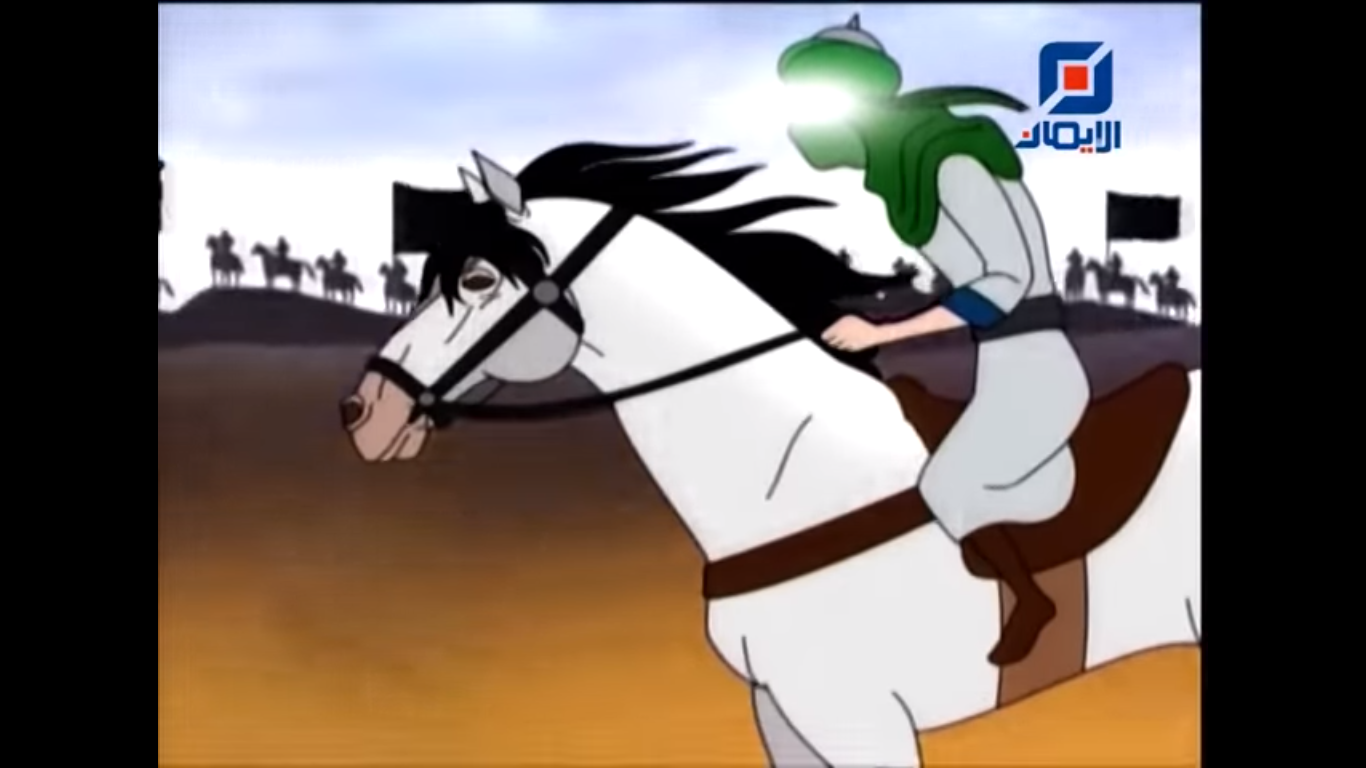
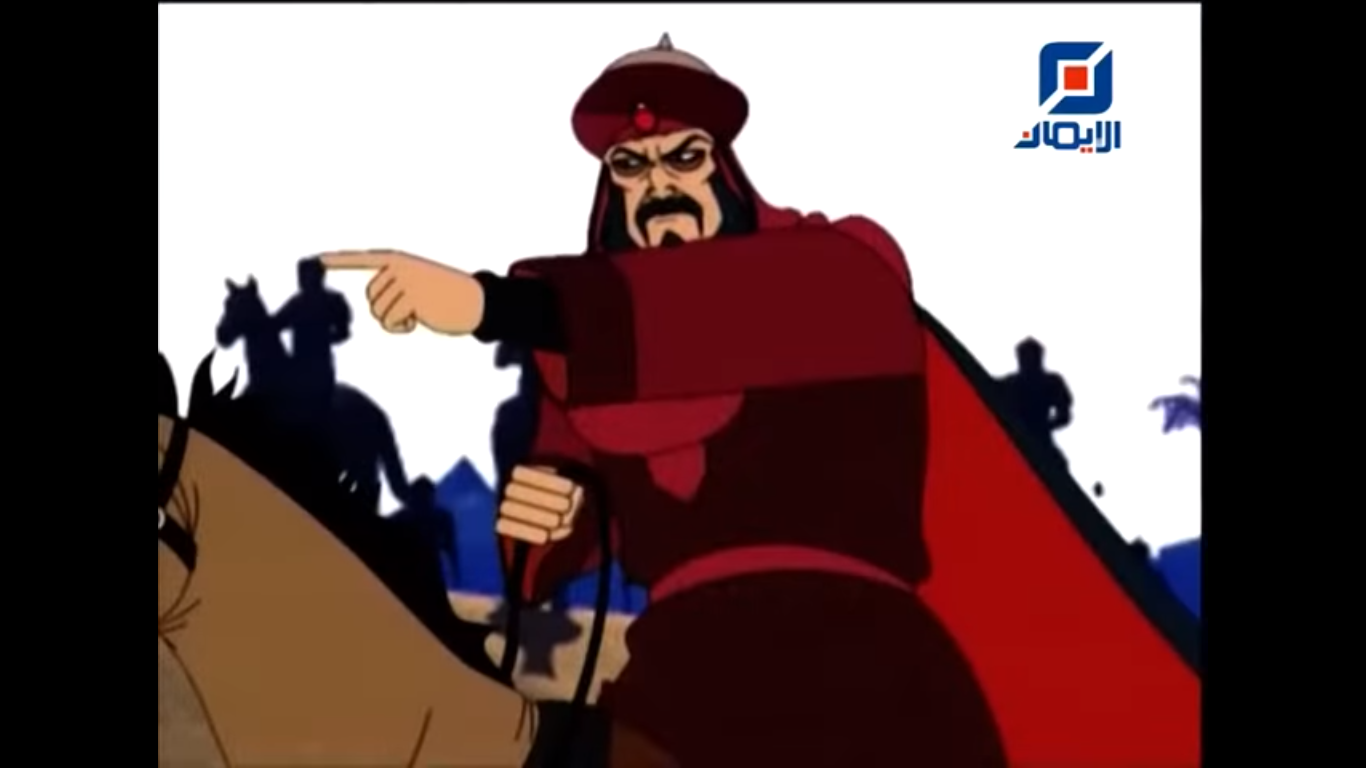
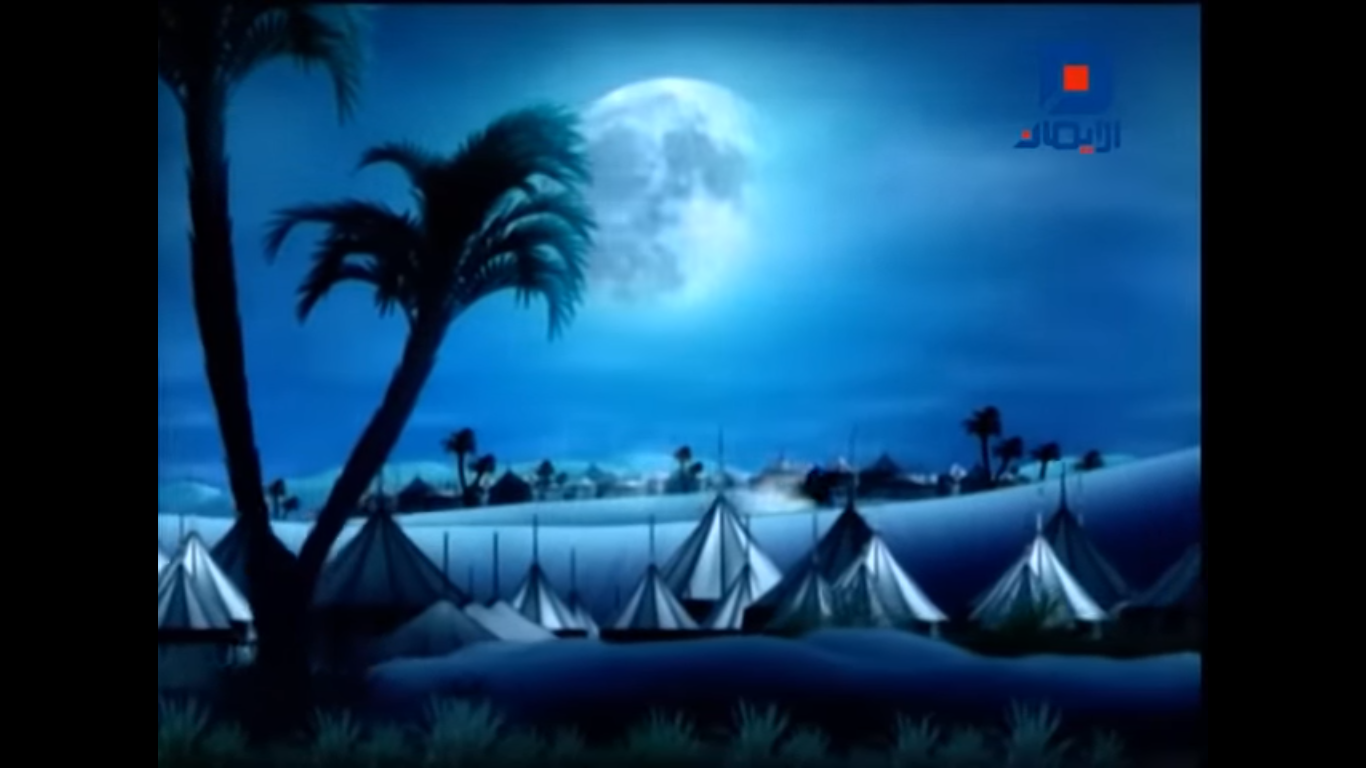
Screenshots from "The Brave Knight".
While Islamic animations of Egypt and Saudi Arabia largely refrain from representing blood even in battle scenes, following Twelver Shi'ism's martyr culture has a more positive approach. The battle scenes of "The Brave Knight" are rather goreish for a cartoon directed towards kids and even include a scene showing an arrow string through one soldier's eye. Despite such religious particularities, the production does not refer to al-Abbas and members of Hussein's camp by terms like "People of the Household" (Ahl al-Bayt), Adherents of Ali (Shiat Ali), or others but defines them as Muslims. Meanwhile, al-Abbas consequently referred to his enemies as unbelievers (kuffar), disregarding the fact that his primary opponent of Hussein, Yazid ibn Mu'awiya, the second caliph of the Umayyad caliphate and his people were also Muslims.
No wonder the film was aired exclusively on Shia television channels in Lebanon, Iraq, Bahrein, and Kuwait and had no access to the Sunni market.
A more compromising account of Shia Islam emerged in 2015 from Lebanon, a country proud of the coexistence between different sects.
"Princess of Rome" is the brainchild of Abbas Sharara, a creative mind and a previous member of the Imam al-Mahdi Scouts, a youth movement established in 1985 by Hezbollah. Although a regional powerhouse in video clip production, Lebanon had no officially backed animation industry; therefore, after setting up his own company, Meem Cultural Production, Sharara partnered up with the Iranian Honar Pooya Group, an advanced animation studio. The producer, Hamed Jafari, and director Hadi Muhammadian are both Iranian.
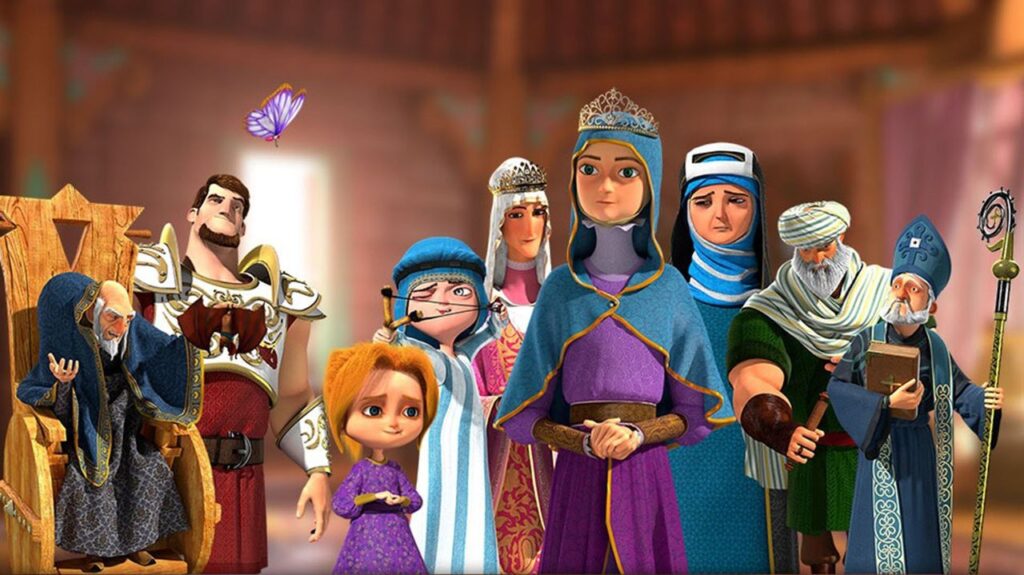
The film is a pixaresque tale of Melika, the granddaughter of the Byzantine Caesar, who became the wife of Imam al-Hadi's son Hassan al-Askari. Therefore, it is respected both by Christian and Shia audiences. The interfaith message is apparent throughout the film: In the title, we see stained-glass icons representing the figure of Jesus Christ, along with Shia imams, whose faces are covered in a blaze.
The plot starts with the desperate Melika looking forward to a forced marriage to an unsympathetic army commander, Krytos, who secretly sees her as a tool to take over the leadership of Caesar. As a relief, the princess has a dream in which Holy Mary and Fatima, the daughter of Prophet Muhammad, foretell her fate of marrying another man and their son, bringing justice to the world. As a divine intervention, Melika is captured and then taken to Baghdad as an enslaved person, where she is purchased to marry Hassan as-Askari, the eleventh Imam (his face is not shown).
At the end of the film, Melika's dream comes to reality as she gives birth to Imam Mahdi, the future savior of humanity. Unsurprisingly, during the film's premiere in Beirut, the Lebanese Minister of Culture Raymond Araiji hailed the film as a bearer of coexistence and a milestone in Lebanese-Iranian cultural cooperation, simultaneously endorsing its capacity as an advocate of peaceful coexistence between Muslims and Christians. Sunni representatives were notably absent at the film's premiere.
An even more inclusive Islamic identity was articulated in 2017 by Abbas Sharara's second feature production, "The Elephant King", also a co-production between Meem Cultural Production and Honar Pooya Group.
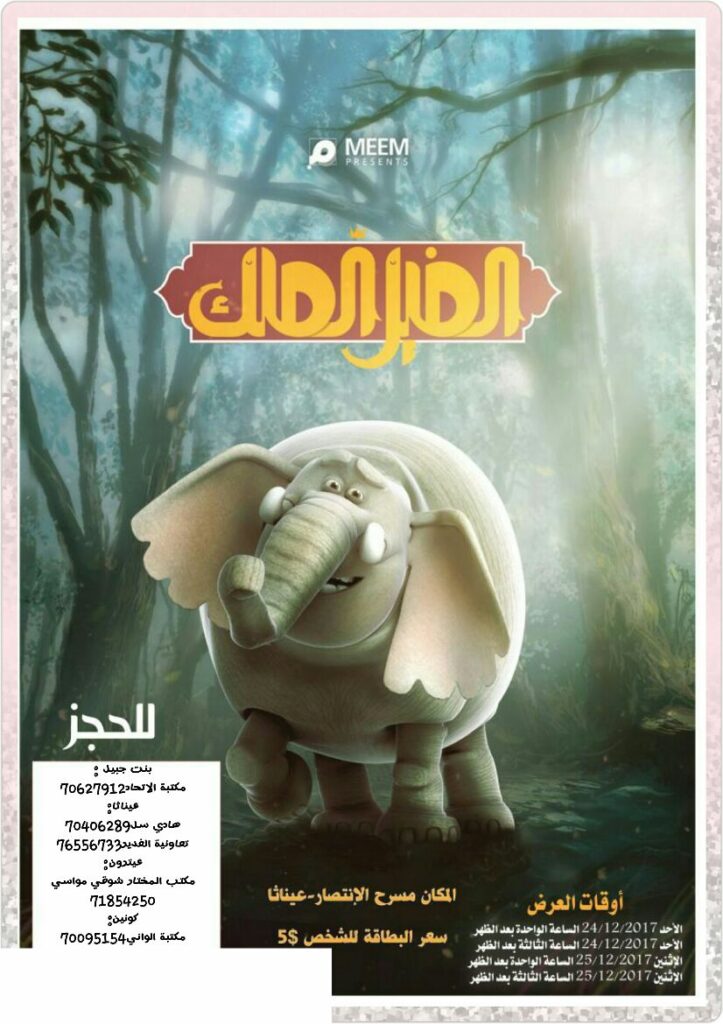
The story was inspired by events mentioned in the Quran's Surah al-Fil. As the Quran tells, Yemen's evil rulers at the time hitched a plot to destroy the Kaaba with the help of elephants, but the attack failed thanks to divine intervention. The film tells a variation of that story via a kind-hearted elephant that was captured in Eritrea and then transported to Yemen, where, along with other animals, it is forced into harsh labor and ultimately befriend a kind little human girl.
"The Elephant King" was translated into French, English, Arabic, and Persian. Nevertheless, similar to "The Princess of Rome," the film was not distributed beyond Shia markets and audiences. Thus, it did not garner widespread appeal or recognition throughout the region.
Despite their limited reach, perhaps restricted due to sectarian bias, all these works are simply fascinating attempts to make cartoons. These productions show sincere effort to use the animation medium in its fullest capacity as a tool to propagate interpretations of Islam and its various sects, especially towards children.
Despite their limited reach, perhaps restricted due to sectarian bias, all these works are simply fascinating attempts to make cartoons.
But is it working? Are children watching these cartoons? Are they enjoying them? Answering that question is challenging considering that publicly available data is very limited and the research and understanding of Islamic animation production - in the region or outside it - is also woefully sparse. If anything, there is something interesting happening here and we need to pay attention.
Categories: Chronicles