‘Bouchra’: Is it better to speak or to die?
Writer and editor Sami Abd Elbaki reviews Bouchra, Meriem Bennani's love letter to her mother, to Casablanca and to the courage of speaking up, set in an anthropomorphic animal world.
A 16th-century question that has been mulled over by philosophers, popularised in film, and memefied by TikTokers. Vulnerability vs regret. In speaking, however, there’s a mini death as well. Something happens when we reveal parts of ourselves; an old perceived image dies, making space for a new-old true one. Words are events. They change things. They hold the power of altering the trajectory of our lives.
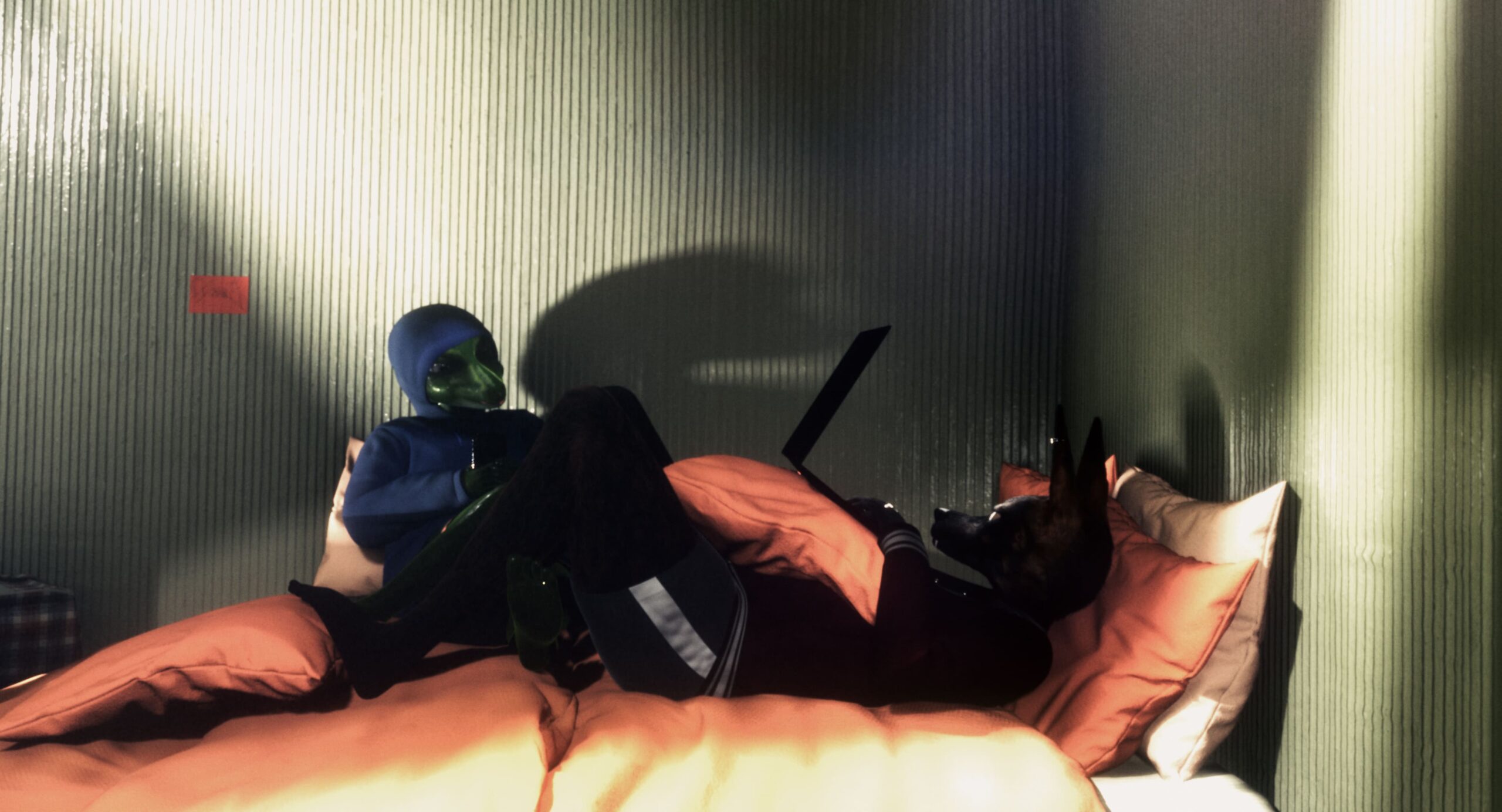
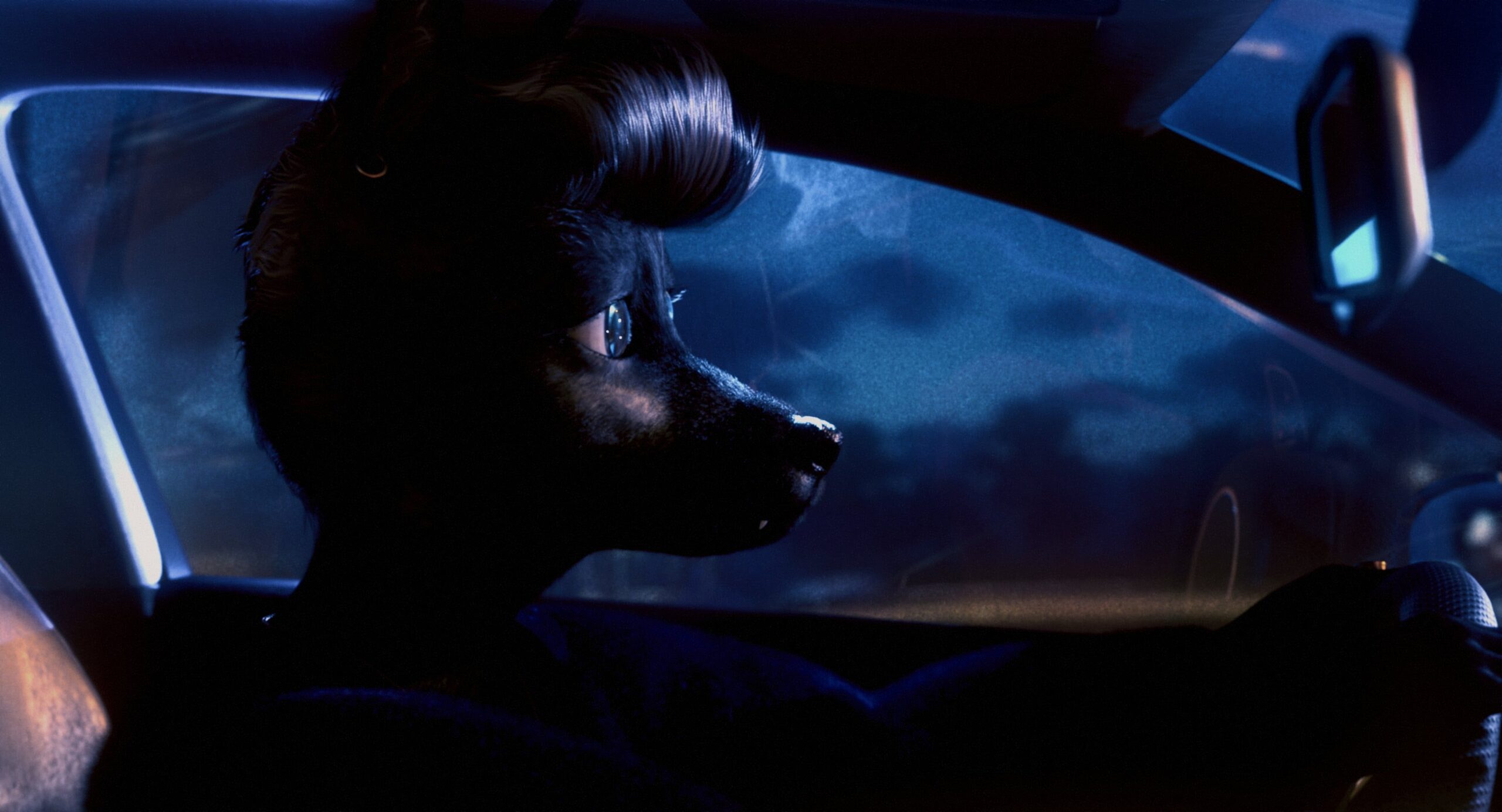
Bouchra, the central character in Meriem Bennani’s eponymous autobiographical first full-feature film, co-directed with Orian Barki, is a Moroccan, queer, leather-jacket-adorned, New York-based filmmaker coyote in her 30s who chooses to speak.
We do not witness that moment. Bouchra, (un)ironically meaning "good news" in Arabic, came out to her mum nine years prior to the events of the film. The news arrived in the rectangular shape of a red envelope, carrying a letter Bouchra wrote for her parents. And as is the case with many Arab families, coming out is an event that happens but doesn't really land. There's a self-imposed amnesia that follows the news, where it gets buried deep in the mind, there but not acknowledged, in the hope that if it's abandoned, if it isn't watered, it'll die on its own. Which is never the case.
Through phone calls, adapted from real-life conversations between Meriem Bennani and her own mother, the two aim to mend, beating around the bush, both scared of confrontation, talking over each other. Both vulnerable. Both shaped by inherited patterns.




Credits: 2 Lizards Production
The film opens with Bouchra on the subway in New York, watching a radio show aptly called "Open Your Heart Out" / khoui qelbek, where lovers call in to vent or ask for a friend. Her viewing gets interrupted by notifications, messages from her mum, and followed by a call, a casual conversation about maderotherapy, Black Friday deals on massages.
Bouchra opens her heart out to her mum and tells her that she's struggling with writer's block while working on her new autobiographical film. Bouchra's writer's block, as is mostly the case with creatives, is not inherently creative. It comes from another source of stagnation and unfinished business in her life. Since the film-within-the-film is about Bouchra's relationship with her mother, she had a few questions to ask about what exactly caused the fracture.
Throughout the film, they attempt several times to have an honest conversation about what caused these years of silence, and about Bouchra not being able to share her life with them because they asked her not to. "Every time I go on a trip with my girlfriend… can you imagine the mental gymnastics I have to do?" Bouchra asks her mum. Aïcha pardons it as prudishness: "Our style is to wait."
"Our style" here could go beyond the confines of Meriem's fictional family to represent a wider segment of Arab families whose style is built on silence and avoidance. Bouchra's mum stands in for a wide group of Arab parents, where even when their children come out to them, it's left untalked about, ignored, treated like nothing happened. They'd rather bury that information in the back of their minds than acknowledge it. The child ends up feeling like they did something, but not really. Coming out is never really the final stop, nor is it the start of a new era.
In no small thanks to Western media and internet culture, coming out is often thought of as a singular event, dividing life into a before of discretion and secrecy and an after ruled by inner peace and self-fulfilment. In reality, it's most often a domino effect, a series of aftershocks triggered by the act of revealing. Bouchra brilliantly captures the anxiety of coming out to your parents, and the false hope of a freedom that never fully arrives. A constant battle of push and pull, of silence, of parents ignoring it and your own Sisyphean task of constantly reminding them.
The phone calls between Bouchra and her mum portray exactly that: Bouchra throwing out a distress call that's received but never answered. And still, it's not a broken relationship. It's not dysfunctional. Bouchra's portrayal of an Arab mum is neither reductive nor villainous.
It's not a broken relationship. It's not dysfunctional. Bouchra's portrayal of an Arab mum is neither reductive nor villainous.
Sami Abd Elbaki
For nearly a decade, they haven't spoken about it, but her mother is not "conservative," as some reviews online call her. Their relationship seems sweet: the mother going to the pharmacy with a scared Bouchra to get her ears pierced; wanting to gift her one of her paintings for Bouchra's new apartment in New York. In return, Bouchra gifts Aïcha a book on Etel Adnan, which I thought was a subtle and brilliant gesture, connecting Bouchra's queerness with Aïcha's love of painting. The two are more similar than a decade of avoidance suggests; they’re both loving, both extroverts, both afraid of elevators.
The elevator oscillates as a recurring visual motif throughout the film. Fitting, given it's the culprit behind their elevatophobia, intertwined with their fear of confrontation. The first time we see it, it's what disrupts the phone call between Bouchra and her mum, true to the film's theme of disconnection. In another scene, it's what brings Bouchra and her mum together in panic mode, much to the amusement of the aunt, who takes them to a restaurant on an impossibly high floor.
But the most telling depiction of the elevator is as a space for Bouchra's inner thoughts and fears. It becomes a stand-in for being confined, stuck in one place with no way out. In the film's most absurd scene, the elevator recites a poem dedicated to Aïcha, while "looking" at Bouchra. The gap between doors serves as its mouth, the sills as moving lips. "Listening is leaning / back and forth," it recites, in a sultry, hypnotic voice. "Slinking, repeating / you know this silence / better than my hand." The silence then becomes a liminal, purgatorial space both Aïcha and Bouchra know intimately. The poem's narration is intercut with shots of Bouchra taking the long, winding spiral staircase up to her apartment instead, choosing the hard road over remaining unbearably stuck in her own head, physically and metaphorically.

Credits: 2 Lizards Production
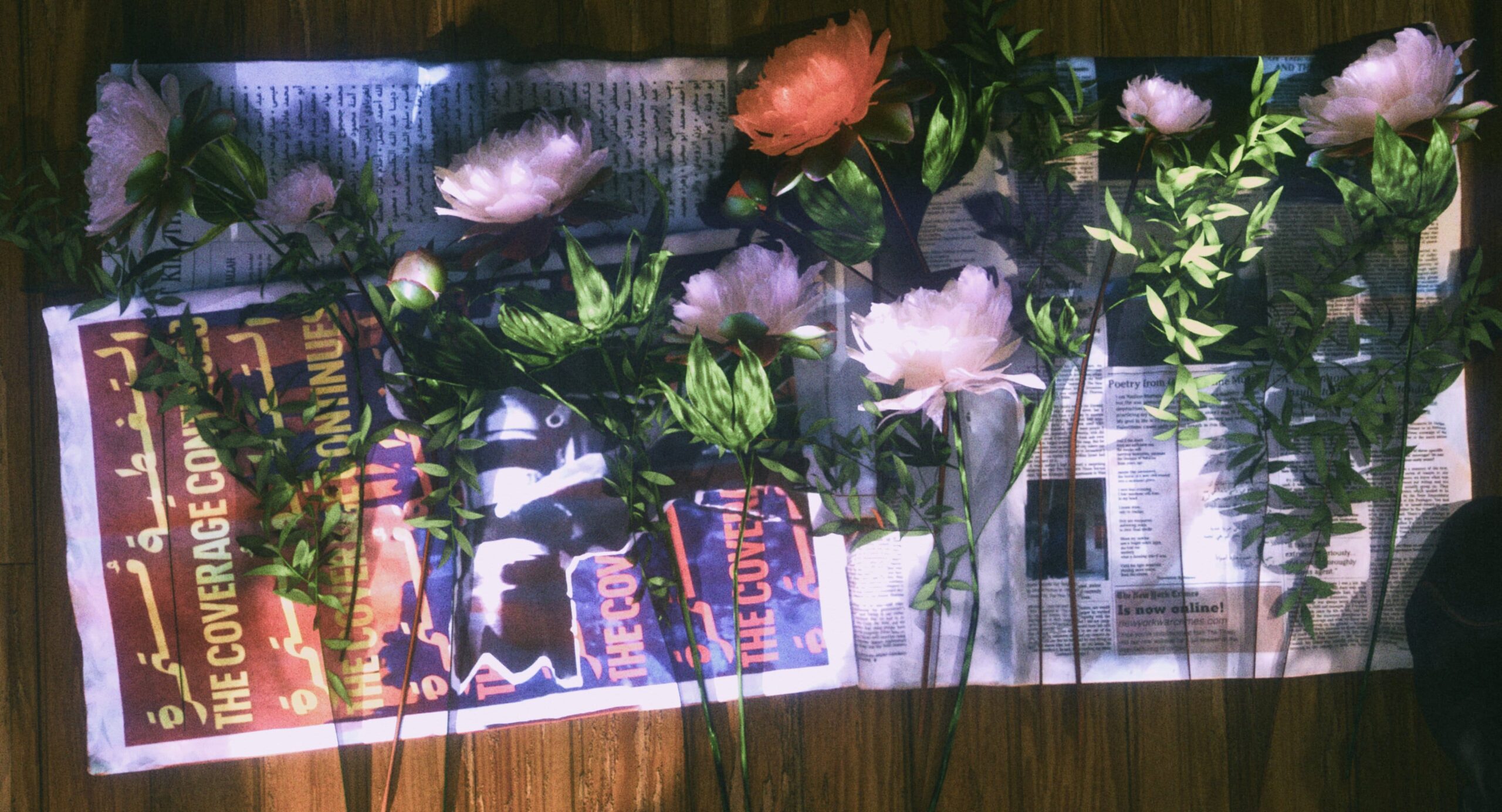
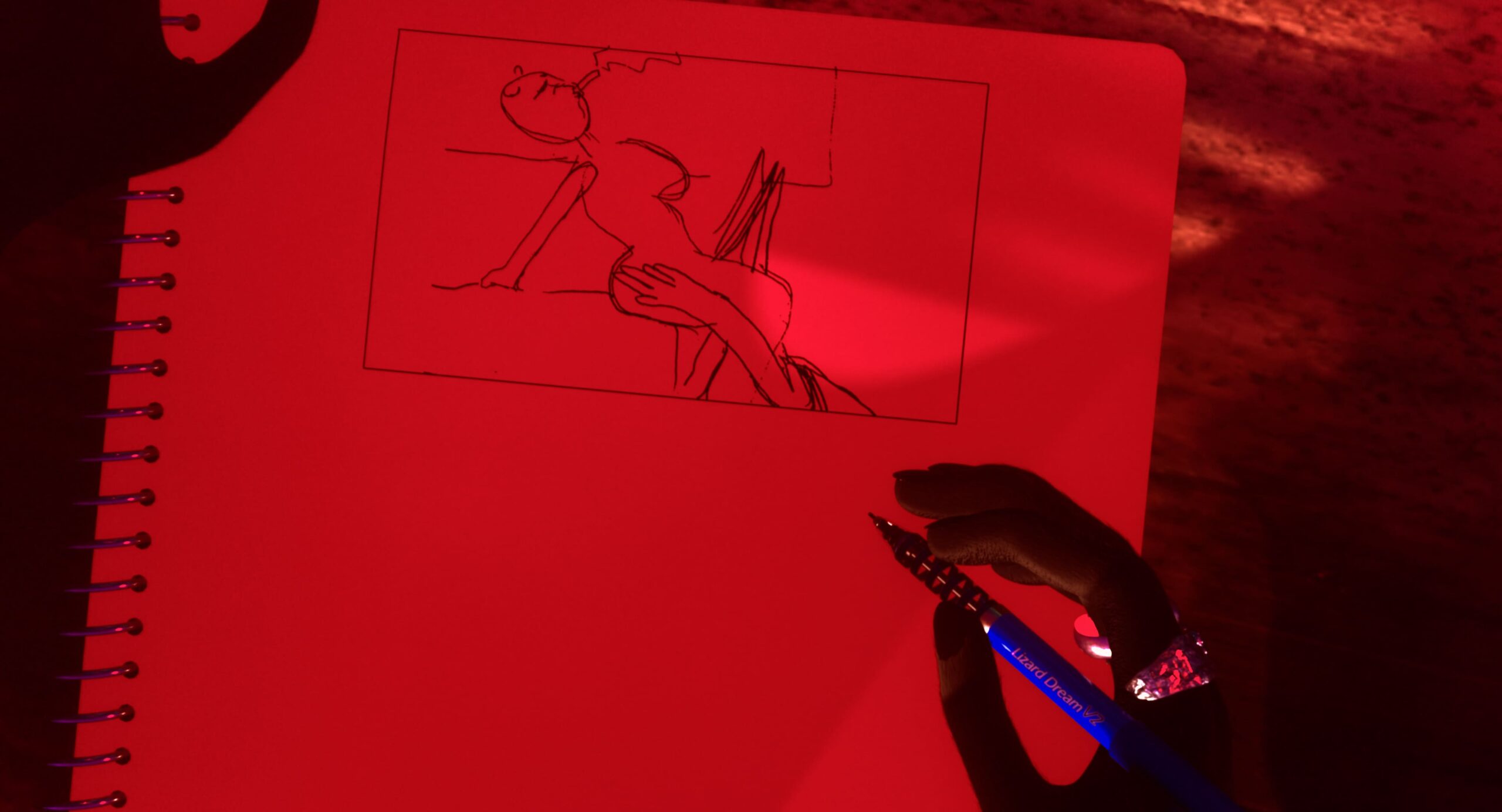
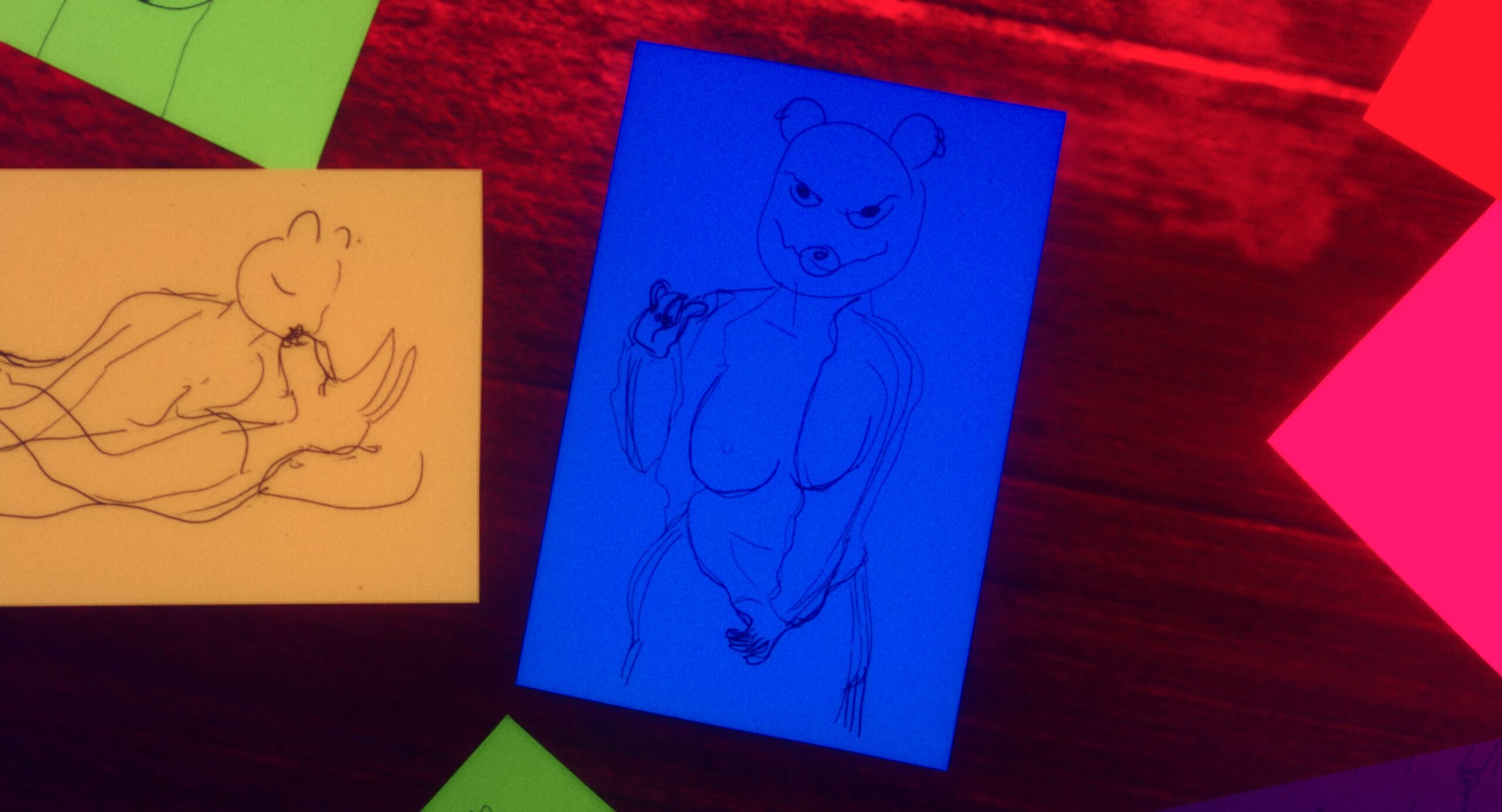
Many other details like her phobia make Bouchra feel painfully human and relatable: a note among a myriad of colourful sticky notes, sketched by Orian, that reads "Cancel ClassPass"; a shot of Bouchra passively watching Is It Cake?; another of her eating snow off a window ledge; her Arabic handwriting glaringly worse than her English; a Palestine keychain hanging from her bag.
Adding another layer of intimacy to the animated film are the voices, which are recorded extremely casually, like a normal, flowing human conversation, with no gimmick or parodic characterisation. Bouchra is voiced by Meriem herself, and her mum, Aïcha, is brilliantly voiced by Moroccan artist Yto Barrada.
But the film's understanding of being ostracised stretches beyond Bouchra's own coming out. Themes of queerness in the film aren't always directed at sexuality but also portrayed as estrangement. Bouchra's aunt, my favourite character, is an example. In a disarmingly heartbreaking scene in the car, based on a real-life moment Meriem shot of her own aunt, she talks about being a single woman in her late sixties, wishing she'd had a partner. She seems shadowed by her sister Aïcha, whom she describes as "such an extrovert."
But the film's understanding of being ostracised stretches beyond Bouchra's own coming out. Themes of queerness in the film aren't always directed at sexuality but also portrayed as estrangement.
sami abd elbaki
The representation of the mother and of Morocco isn't reduced to any stereotype but is instead tethered to Meriem's own experiences. Despite leaving Morocco, Morocco never really left Meriem; it's always been present in her work, from Fardaous Funjab (2015), a satirical faux-reality-TV series imagining a fictional Moroccan "funjab," to Siham & Hafida (2017), a multi-channel installation centred on a feud between two Moroccan chikhas. Something changes in your relationship with your country as a queer person. It falters, takes a different shape, finds forgiveness. The Moroccan settings in Bouchra were built using photogrammetry and reference photography, down to signage and old design magazine clippings of Bennani's parents' furniture, which were scanned and rebuilt in 3D, which is part of why the world feels so specific and lived-in rather than a generic "animated Morocco."
At one point, Aïcha admits that when Bouchra first came out to her, her first thought was that Bouchra could no longer live in Morocco. The film, originally titled For Aïcha, is a love letter to the mother, but also to Meriem's first mother: Morocco. The Moroccan setting feels real precisely because it is; someone photographed it, down to the signage and the domestic clutter, not the Morocco that's packaged and exported. The film doesn't try to "be Moroccan" to claim a representation badge. It simply is.
Bouchra was originally developed as a commission for Fondazione Prada, the Italian cultural institution headed by Miuccia Prada, under the title For My Best Family, by Meriem's own account, the most ambitious project of her career, over two years in development. The project ran across two levels of the Fondazione's Podium building, with Sole Crushing taking over the ground floor: a large-scale mechanical installation inspired by Arab mums throwing slippers at their kids, animating 192 flip-flops and slippers via a pneumatic system into what's been called a "ballet-symphony-riot," striking wood, metal and glass to produce different sounds. The soundtrack was co-composed with Moroccan producer Reda Senhaji, aka Cheb Runner, who also scored Bouchra. The Podium's second level, meanwhile, was converted into a miniature version of Fondazione Prada's own Cinema Godard, complete with rows of the theatre's actual chartreuse velvet seats, to screen the film, then titled For Aïcha, at its original 73-minute Milan cut, later extended to 83 minutes for festival release under its new title, Bouchra.
Cheb Runner was also, in fact, part of the film’s sound team, giving the two works a shared musical spine. Bouchra’s sonic world includes a beautiful recurring main theme scored by Flavien Berger, a jazzy, hypnotic, intriguing, haunting, scaling up and down like a moth fluttering around a light with curiosity, uncertainty, danger, and it also includes a plethora of North African bops from all the Chebs, Chebas, and Cheikhas.
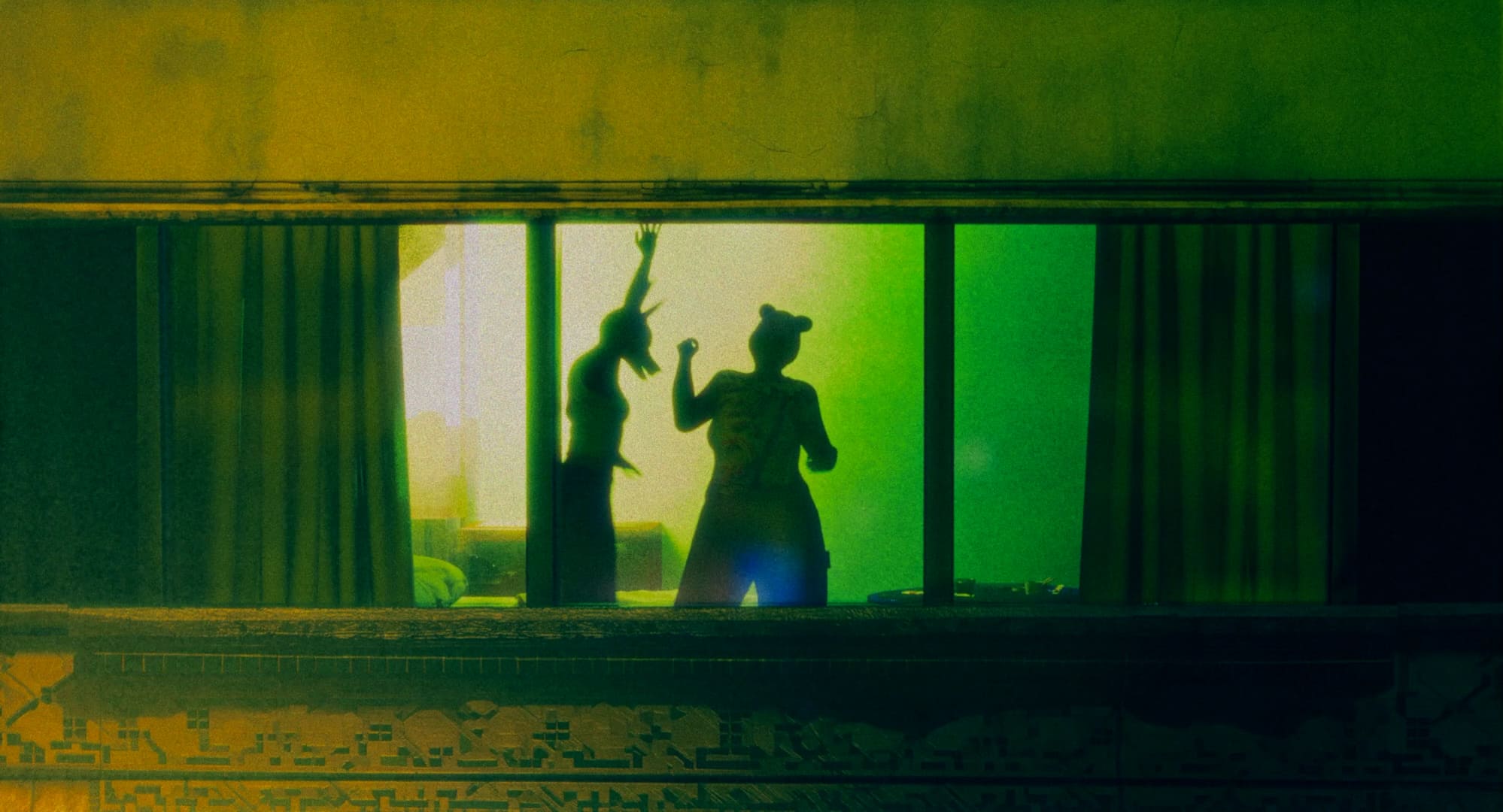
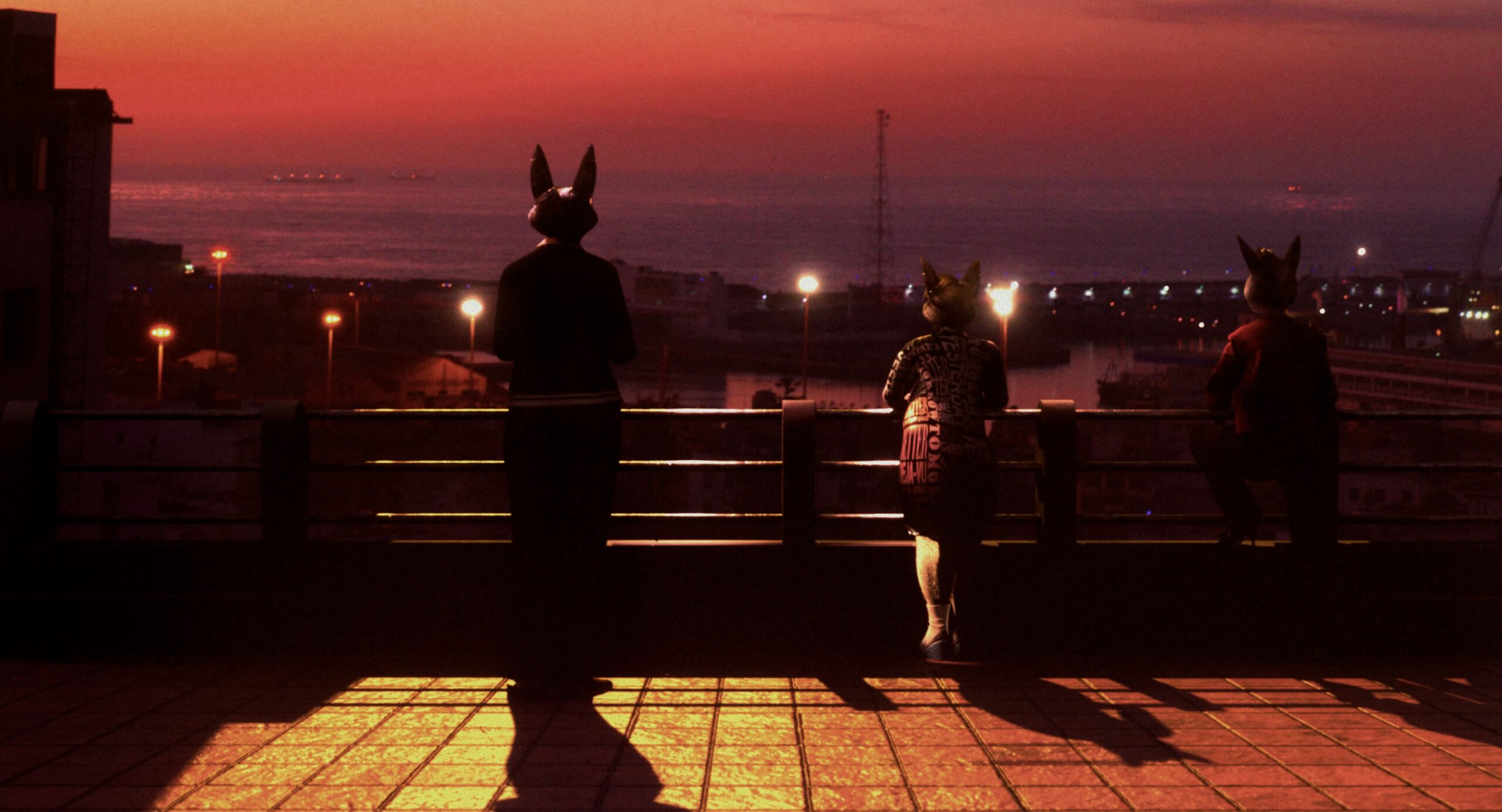
Stylistically, the film is a work of 3D computer animation led by Jason Coombs, built in Blender and rendered with real texture and lighting rather than the flatter, glossier look a lot of arthouse animation goes for. It carries over the visual DNA of 2 Lizards, Bennani and Barki's earlier lockdown web series and first collaboration, just with a much higher production budget and polish behind it. The animation is deliberately paired with completely unstylised, naturalistic voice performances with no cartoon inflexion, which is part of what makes the photoreal-animal, ordinary-human-voice combination land instead of feeling gimmicky.
Meriem has worked with real-life footage in her previous projects, but the choice of anthropomorphic animated characters here gave the creators more freedom, and perhaps let them sidestep the discourse of identity and representation altogether. Yes, the doe-eyed coyote is Moroccan. But she's also a coyote. The film raises the question of how much license an animated character is granted that a human one wouldn't be. How much is an Arab character allowed to get away with, sexuality included, precisely because it isn't real? It made me think of Abla Fahita, the Egyptian puppet with her own TV show, a Netflix original, and red-carpet appearances where she flirts with attendees using sexual innuendo. It made me think of Dr Alfons, another Egyptian puppet, a senior citizen, also flirtatious. As of the time of writing, the film hasn't screened in Morocco, but Meriem has mentioned on Instagram that she's trying to make it happen, which would be wonderful to witness.
By the end of the film, our beloved Bouchra hasn't changed much. This isn't a plotline where a radical change transforms our character. She chooses to speak, and keep speaking, long after the letter's been read and reread and left in a box in Aïcha's art room. The coyote hasn't really changed much. Her mother hasn't either. But something in the space between them has. Similar to coming out itself, the person is still the same person.
CREDITS
Direction: Meriem Bennani & Orian Barki
Creative production: John Michael Boling & Jason Coombs
Starring: Fayçal Azizi, Ariana Faye Allensworth, Hassan Hamdani, Yto Barrada, Dounia Berrada, Bouchra Benzekri, Salima Dhaibi, Lil Patty
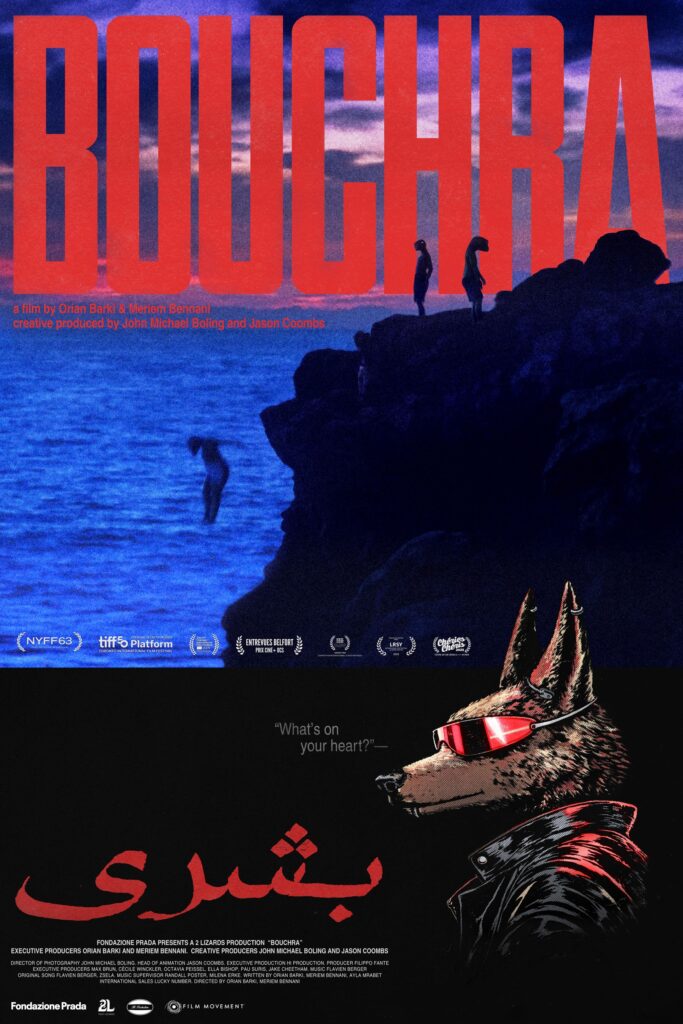
Official Poster - Credits: 2 Lizards Production
Categories: Reviews