Once Upon a Time in…Algeria
How can animation function as a platform to articulate and negotiate national identity in the Arab world? Algeria provides a perfect case study.
The history of Algerian animation production dates back to the 1960s. Like other 'Western' art forms, formats, and genres, animation found its way to Algeria through the local francophone-educated elite during and after the colonial period. French authors and productions were one primary source of inspiration for early Algerian artists, including Mohammed ʿAram (1934-2020), the pioneer of Algerian animation. ʿAram released his first work, “The Tree Party” (La fête de l’arbre) in 1963. The plot conveys a message of peace and non-particular identity with its plea for replanting forests destroyed by napalm. Therefore, it serves both as a memento to the peace movement that was then in its early days in response to the horrors of the Vietnam War and a reference to the Algerian villages that were burned down with napalm by the occupying French army.
A true milestone arrived in 2012 with “Algeria History and Civilization” (Al-Jaza’ir Tarikh wa Hadarah), a monumental, chronological overview of the history of Algeria from the creation of the kingdom of Numidia in antiquity until the end of French colonial rule in 1962, aimed for children under 18.
Mohammed ʿAram, a self-taught animator, produced his black-and-white celluloid short films without receiving funding from the local government or cinema authorities. Although he did not develop a personal style, ʿAram's animations carry an Algerian identity, as they are set in local environments. ʿAram trained a team of young artists with whom he produced around twenty largely self-funded short productions between 1963 and 1999. Many of the films had a social dimension, like dealing with illiteracy in the 1963 film, "Ah, If Only He Could Read" (Ah, s'il savait lire) and with urban health problems in the 1964 film "Microbes of the Garbage Cans" (Microbes des poubelles). Politics was off Aram's table.
From the early 1990s onward, several Algerian animators were employed in the European and Arab animation industries. But still, lacking funding, education, equipment, and support from local media industries, Algerian animation did not gain momentum for decades to come. A true milestone arrived in 2012 with "Algeria History and Civilization" (Al-Jaza'ir Tarikh wa Hadarah), a monumental, chronological overview of the history of Algeria from the creation of the kingdom of Numidia in antiquity until the end of French colonial rule in 1962, aimed for children under 18. The fifty-two-episode series, with a budget of 50 million dinars (US$ 600,000), was produced by al-Buraq, an Algiers-based studio, and was funded mainly by the Ministry of Mujahedeen and the Ministry of Culture.
But why was "Algeria History and Civilization" so significant politically? To answer the question, we should take a glimpse at Algeria's struggle for independence and the process of rewriting Algerian history. The conflict between colonial France and the Algerian independence movement endured from 1954 to 1962, resulting in approximately 200,000 casualties and ranking as one of the most brutal decolonization struggles in the Arab world. Even after achieving independence, the notion of national unity was overshadowed by the violent clashes of 1962 and the coup d'état in June 1965. The French and francophone intellectual elite employed historical narratives to justify their presence and policies in Algeria. To emphasize Algeria's European connections, the education system emphasized the ancient Roman, Latin, and Christian eras while portraying the Berber-Arab and Ottoman periods as "dark ages" characterized by oppression and barbarism.
Since declaring independence, particularly from the 1970s onward, governments have invested significant efforts in shaping their narratives of history, employing it as a strategic decolonization strategy. The National Centre for Historical Studies was founded in the 1970s and was later attached to the Ministry of Interior. Firmly institutionalized, Algeria entered a period of writing and rewriting history. Two major goals were to achieve: proving the continuity of the Algerian nation and rectifying the assumed falsifications made by colonial historiography.
Doing so, the Islamic past and its significant events, such as the Muslim conquest of the Maghreb and the Almohad and Ottoman periods, became central, as did Andalusia, which was under Muslim rule from 711 to 1492, and came to be remembered as a "lost heaven". Even more importantly, narratives on the War of Independence became the backbone of the political legitimacy of post-independence governments and one of the most critical factors in shaping modern Algerian identity. Under the presidency of Shadli Bendjedid (1972–1992), the National Organization of Mujahedeen (ONM) gained a monopoly on gathering and archiving documents on the War of Independence. It was hence authorized to write its own version of that historical period.
And now, back to animation. Visually, the influence of anime on the producers of "Algeria History and Civilization" is apparent. Instead of creating indigenous artistic styles, the animators opted for a Japanese aesthetic in animating characters and illustrating backgrounds, with some noticeable French influences. The episodes of the series employ a framed narrative structure reminiscent of the French animation series, "Once Upon a Time…" (Il était une fois…) created by Albert Barillé, aired from 1978 to 2008 across seven series. In each episode, an animated narrator takes on the role of a professor-like figure, sporting a bearded appearance, glasses, a yellow shirt, and a green tie. This narrator stands beside a chart displaying either the title or actual maps. After briefly introducing the historical era, the narrative transports viewers back in time, acted out by animated characters representing historical figures.
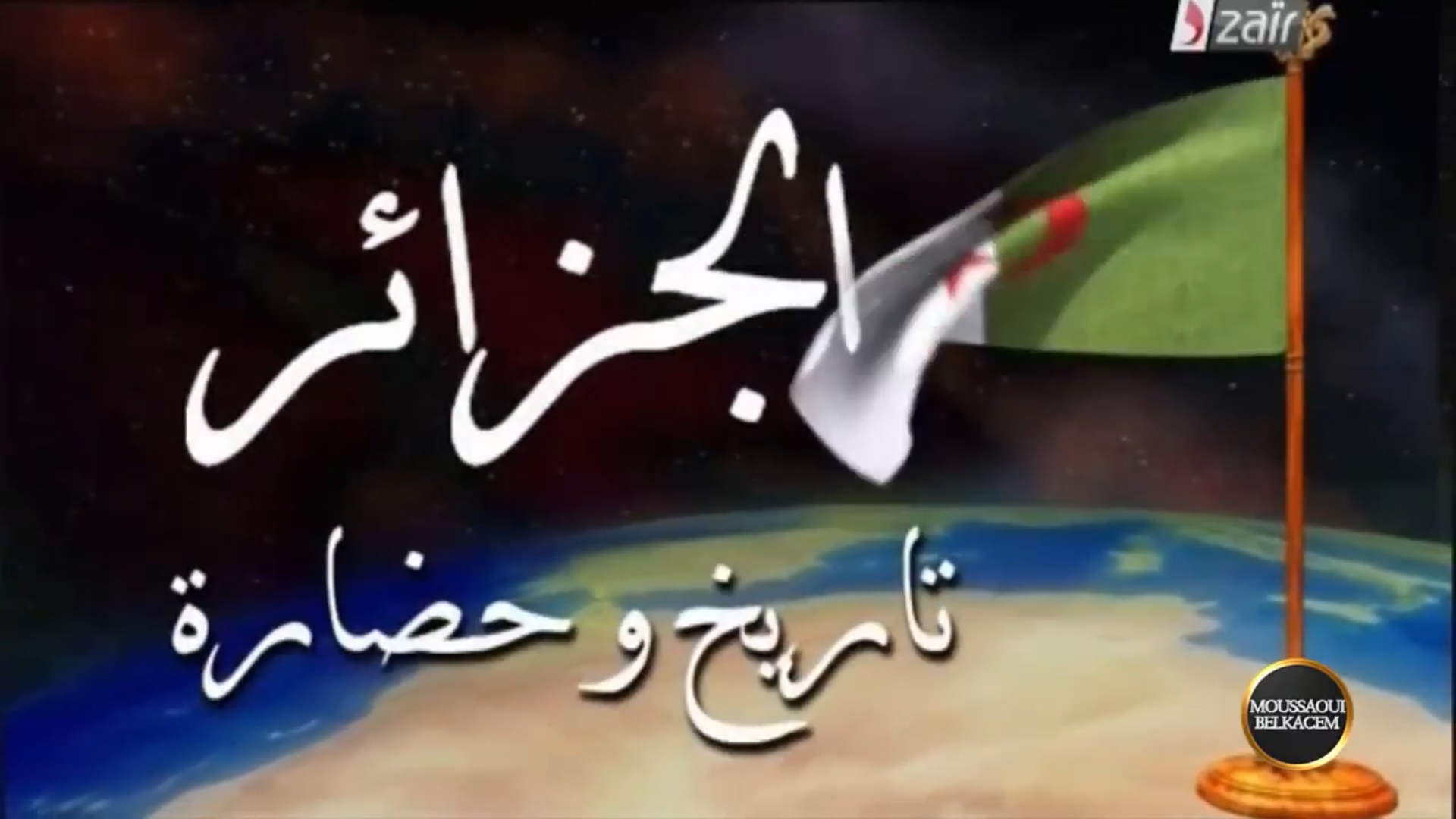
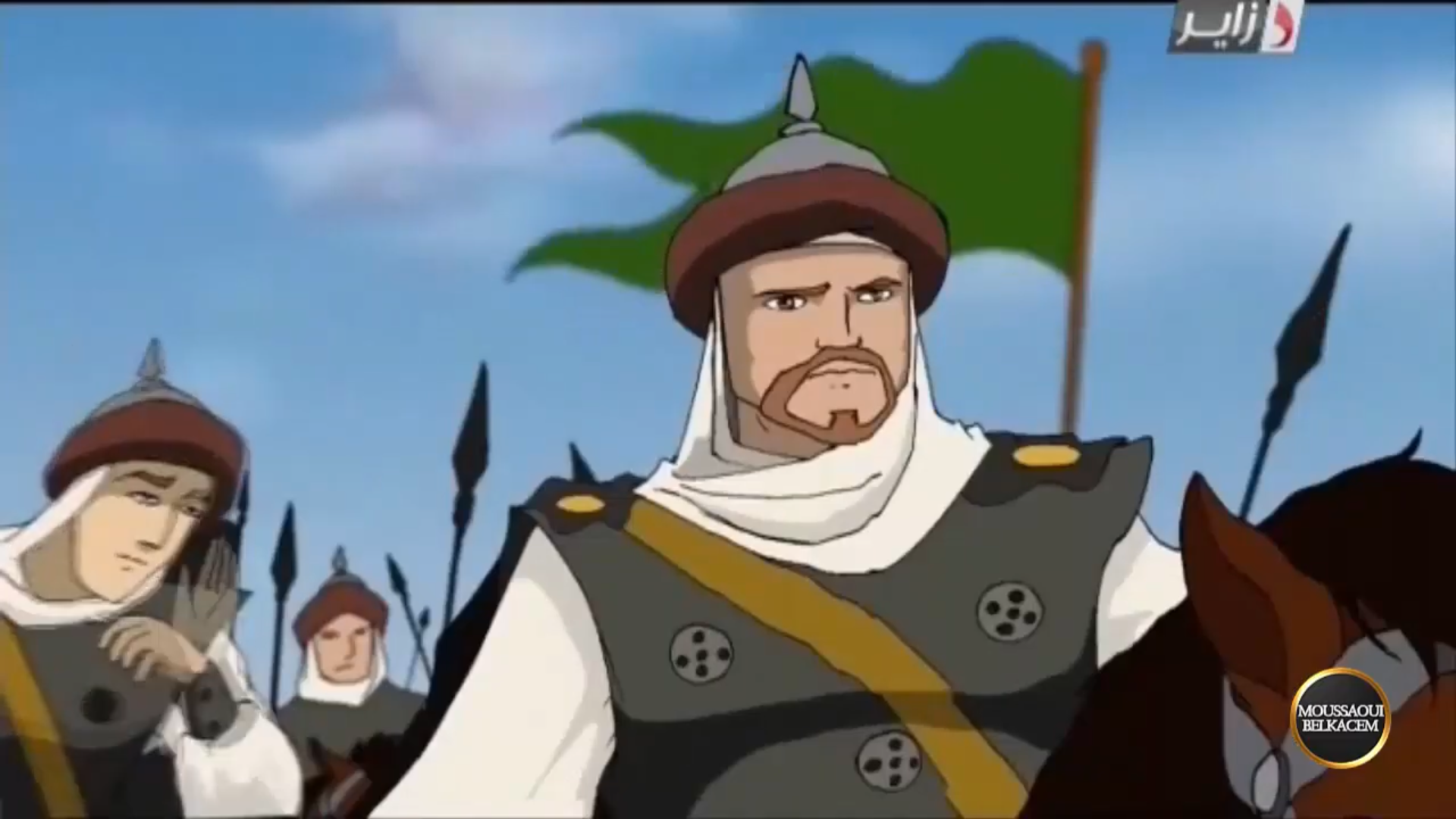
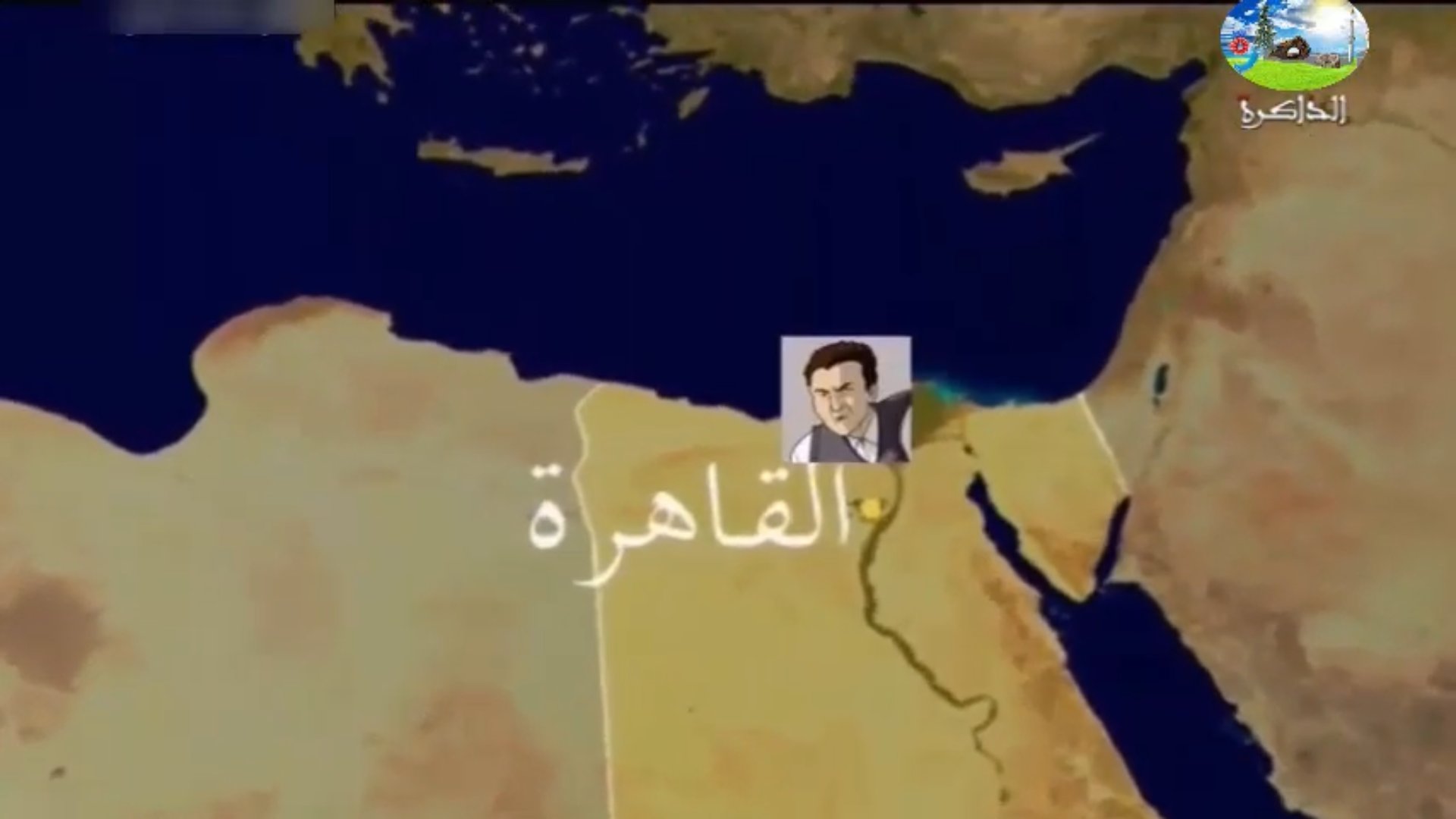
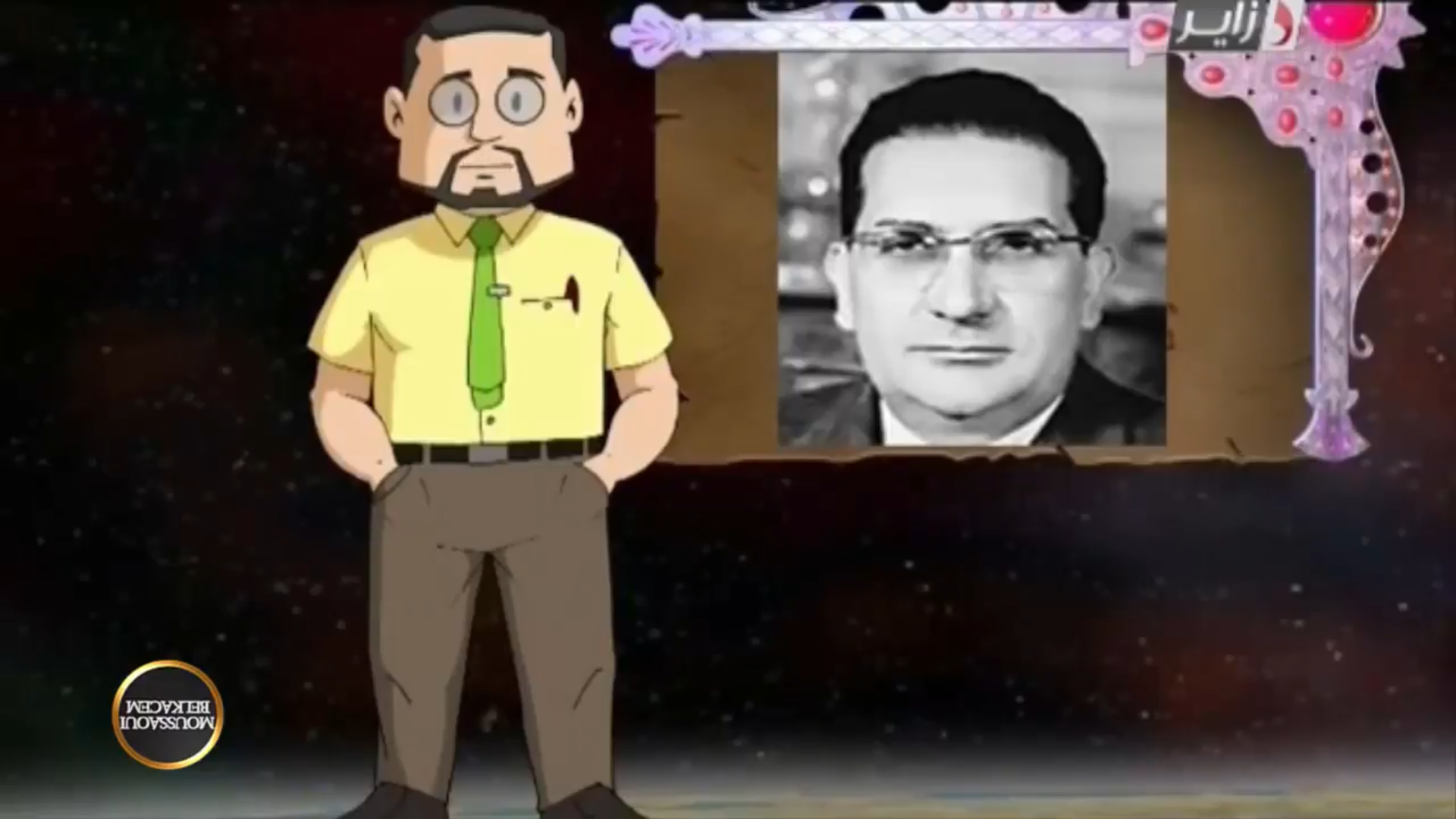
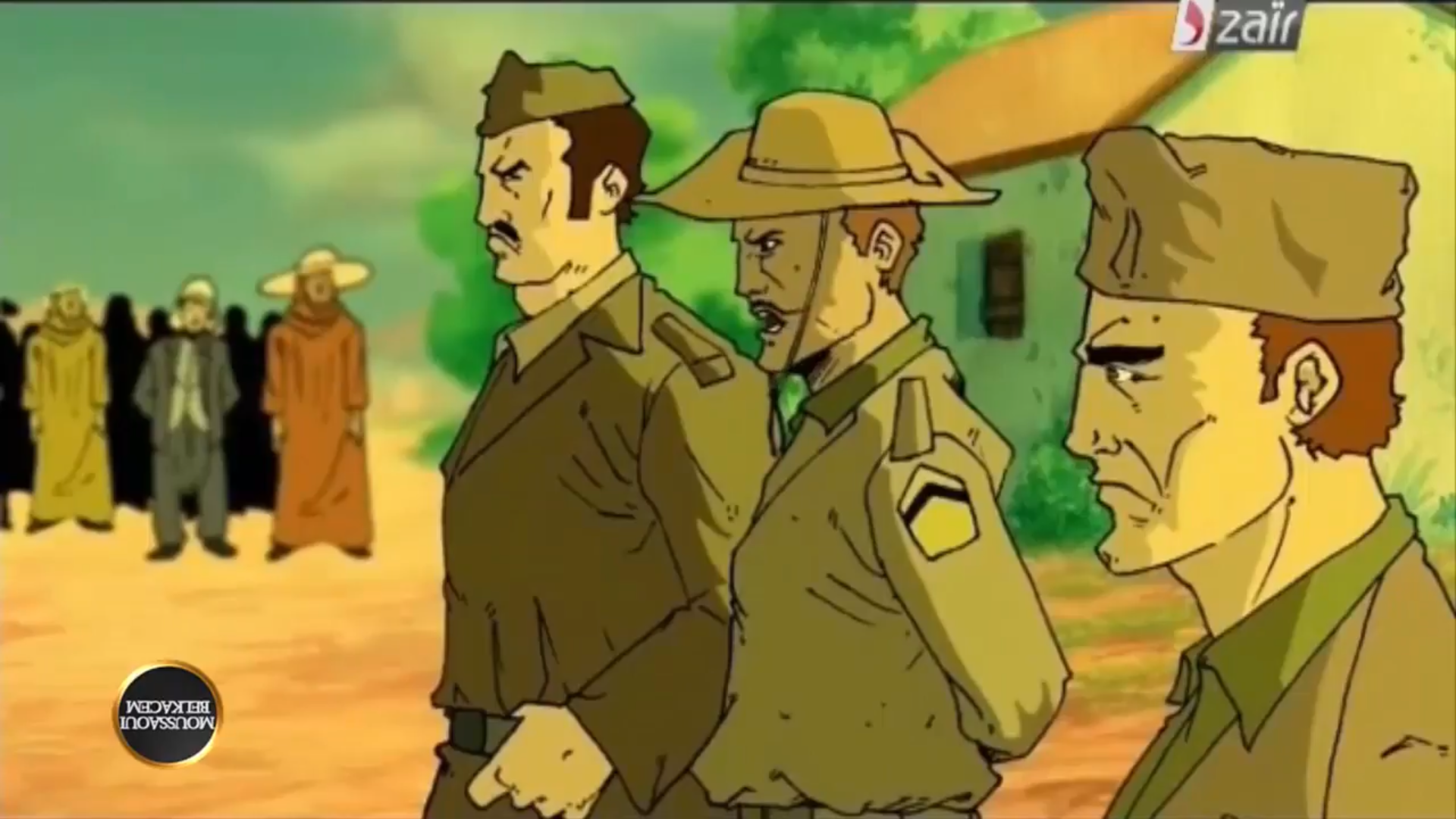

Screenshots from "Algeria History and Civilization".
The language of the series is generally fusha Arabic, adding an extra dimension of reliability to the series as a source of historical knowledge. However, the episodes covering the struggle for independence in the twentieth century are dubbed in the local Algerian dialect to allow viewers to better identify with the characters. Unlike the colloquial dialect of modern Algeria, the dialect of these particular episodes is generally stripped of French phrases to stress the country's cultural uniqueness.
"Algeria History and Civilization", through its institutional background in production and funding, established a sense of historical continuity in Algeria, spanning from ancient times to the twentieth century. The episodes emphasize the Islamic identity of the nation, portraying modern Algeria as a cohesive entity both geographically and culturally rather than solely as a nation-state. The historical events depicted extend beyond the borders of present-day Algeria, encompassing the broader Maghreb region, with particular attention given to Algiers and the expansive territory of modern Algeria.
When discussing non-Arab Muslim leaders or groups, their ethnic background is neither concealed nor emphasized. Instead, the focus is on their Islamic identity, as seen in episodes covering the Almohads. Although their Berber ethnicity is mentioned from the outset, they are primarily called "Muslims." This is unsurprising, as the Almohad Dynasty has historically been the main reference to Berber ethnic identity in twentieth-century Algerian discourse.
However, following independence, the development of Algerian "official culture," history, and national identity has predominantly revolved around an essentially Arab-Islamic Algeria. President Abdelaziz Bouteflika (1999-2019) did not yield to the Berber community's demands for cultural equality, and opposition from the Berber population, particularly in the Kabylia region, has faced ongoing repression.
The narrator categorizes the non-Muslim rulers of present-day Algeria as either "occupation" or "colonization" while referring to the Muslim rulers as a "period," regardless of their ethnic or sectarian background. In this context, Algerian Sunni Muslims consider the Ottoman Turks and Shia Fatimids as legitimate rulers of the country. When recounting the conflicts between the Ottomans and European powers, the Ottoman army is described as a "Muslim army" (jays al-muslimin), and its victories, such as Hasan Agha's triumph over Christian pirates during his reign as the ruler of the Regency of Algiers from 1533 to 1545, are commemorated with a strong sense of pride.
Unlike the colloquial dialect of modern Algeria, the dialect of these particular episodes is generally stripped of French phrases to stress the country’s cultural uniqueness.
As we saw, animation can inspire at least as much cultural authority and legitimacy for teaching political and historical narratives as school textbooks. Since its release, the series has been broadcast on Algerian state television numerous times, providing tens of thousands of children with an entertaining introduction to the state's preferred historical narrative. Did Algeria History and Civilization succeed in rewriting the country's history?
It is for the children to tell.
Categories: Chronicles